
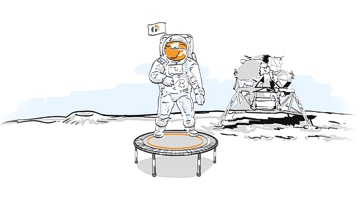
This study demonstrated the extremely positive effects of trampoline jumping on fitness and sparked public interest in trampolining, with the study’s conclusion put simply: rebound exercise is “the most efficient, effective form of exercise yet devised by man.”
In terms of heart rate, oxygen uptake and muscle stimulation, other forms of exercise such as jogging require significantly longer and more intense training to achieve the same effect. It’s therefore no surprise that astronauts still train regularly on trampolines today, to help prevent bone and muscle loss.
Trampoline training is effective and easy on the joints
The study compared training on a treadmill with training on a trampoline, with striking results:
- While the acceleration forces measured during treadmill training were more than twice as high at the ankles as at the back and forehead, the values measured on the trampoline were roughly the same at all three measuring points.
- On the treadmill, the forces acting on the ankles and knees were very high, explaining the frequent training injuries in this area. On the trampoline, by contrast, the loads on joints and ligaments stayed well below the threshold at which injuries occur.
- At the same oxygen uptake, the work performed on the trampoline was up to 68% higher than on the treadmill — making “rebounding” a significantly more effective form of exercise than running.
- Training on the trampoline was most effective when acceleration forces were kept under 4 g. (Normal training on the highly elastic bellicon® reaches no more than 3.5 g.)
Training on the bellicon® trampoline is therefore the ideal training method, and thanks to its lower impact, is also suitable for older adults or people recovering from an injury.
Sources (paywalled):
“Body acceleration distribution and O2 uptake in humans during running and jumping.”, by A. Bhattacharyae, P. McCutcheon, E. Shvartz and J. E. Greenleaf
Biomedical Research Division, NASA-Ames Research Center, Moffett Field, California 94035; and Wenner-Gren Research Laboratory, University of Kentucky, Lexington, Kentucky 40506
http://www.ncbi.nlm.nih.gov/pubmed/7429911