
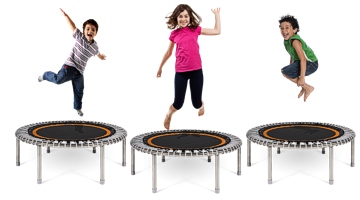
In a study by the Bavarian Julius Maximilian University of Würzburg involving 25 kindergarten children, researchers examined how the so-called “motor quotient” (a standard value for measuring the level of motor development in preschool-age children) develops over the course of different types of training.
One half of the children (from the city centre) carried out a regular exercise programme on a highly elastic bellicon trampoline over a period of 9 weeks. The other half of the children (from the outskirts of town) completed a normal sports-pedagogical children’s training programme using conventional methods at the same time.
The “trampoline children” started out with an average baseline level of 95 as their motor quotient (MQ). The “control children” from the outskirts had a measurably better level of motor skills to begin with, with an MQ of 98.
Results:
- The MQ of the “trampoline children” rose by 12.6%, from 95 to 107.
- The MQ of the “control children”, by contrast, rose by just 5.1%, from 98 to 103.
- The “trampoline children” not only achieved greater gains, they even overtook the other children in their motor performance.
Conclusion:
Thanks to its high fun factor, the highly elastic trampoline was used again and again by the children voluntarily for playing and bouncing. In doing so, they unconsciously also improved their fitness.
Determining the motor quotient (MQ):
For a series of motor tasks, 0-2 points are awarded depending on performance. The sum of all points gives a raw score. This is then evaluated using standard tables, taking the child’s exact age into account. The motor quotient is thus derived from the raw score.
The MQ value distinguishes between very good (145-131 MQ), good (130-116), normal (115-86), below average (85-71) and conspicuous (70-56) results.