
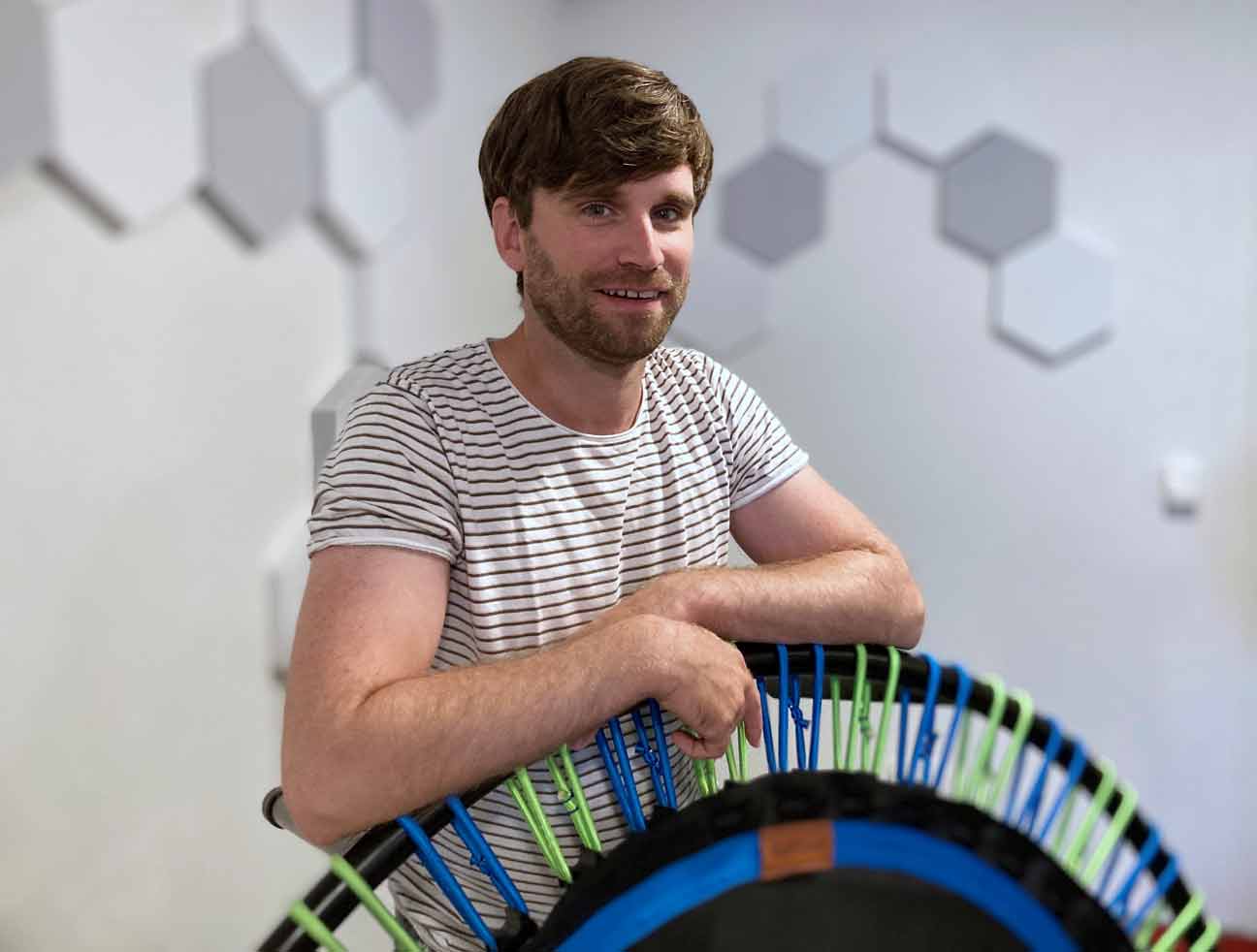
Between September 2019 and June 2020, Axel Heil, together with Manuel Feisst and Juliane Dennert, conducted a study with 20 professional classical singers. The study examined vocal performance under the influence of targeted mini-trampoline training on breath stability and breath control.
Subject of the study and participants
The 20 study participants were divided into two groups: the control group continued their singing work as usual, in order to maintain or expand their existing level of performance. The intervention group trained with targeted mini-trampoline training over 36 weeks (6 training units of 42 days each) in addition to their everyday singing work.
The study participants were professional singers taking part in coaching with Axel Heil, the study’s initiator. The mini-trampoline training was carried out with a bellicon® mini-trampoline in each case.
For the mini-trampoline training, 6 videos were produced and a training programme of 6 x 6 weeks each was set up. Each of these videos was 20-30 minutes long and had to be practiced 21 times within the 6 weeks. The training course was divided into a familiarization phase, a coordination phase, two intensification phases, and two stabilization phases, each corresponding to one video and thus 6 weeks of training. The subjects documented their training in a digital diary. Before the start of the first training video, as well as three times every 12 weeks after the start of training, a range of variables were measured.
Results
Table: Difference between the baseline (start of the study) and week 36. Source: M&M 2021, No. 2, Vol 28, p. 79.
The researchers found that the sustained hissing duration at a stable frequency, as well as the phonation duration, became significantly longer for the group training with the mini-trampoline. The difference in duration and frequency of the remaining parameters did not increase, or increased only insignificantly, with longer training duration. Furthermore, no correlation was found between forced vital capacity and maximum phonation duration.
From this, the researchers concluded that mini-trampoline training, based on breath coordination, significantly improves the performance of professional classical singers compared with everyday singing work alone.
The full study was published in the journal of the German Society for Music Physiology and Music Medicine (M&M 2021, No. 2, Vol 28, pp. 73-81).
More on the study here.