
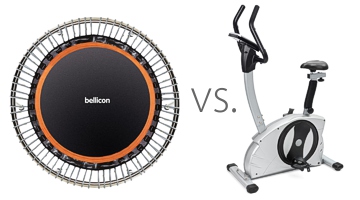
Scientific results from the use of the highly elastic trampoline in home exercise therapy for heart patients at the Bad Gottleuba Cardiovascular Clinic. Produced by Dipl. Päd. S. Biener, head of physiotherapy at Bad Gottleuba Clinic, and Dr. C. Altmann, chief physician of cardiology at Bad Gottleuba Clinic:
At the clinic, a comparison test with bicycle ergometers examined to what extent training on the highly elastic, spring-suspended bellicon® mini-trampoline is suitable for training heart patients.
Results
- Trampoline ergometry makes it possible to define therapeutically meaningful and cardiologically justifiable movement sequences on the trampoline that can be carried out at home as part of daily training.
- The movement forms developed on the trampoline are effective, safe, and, due to the high emotional attachment to the device, result in superior adherence to therapy among properly prepared patients.
- The exercises are particularly suitable for patients for whom conventional forms of movement appear problematic, such as severely overweight patients with joint problems in the lower extremities and patients with heart failure.
- Thanks to the additional demand for an upright posture and coordination, as well as the fun factor, independent therapy at home on the trampoline results in more quality of life and better adaptation of the heart patient to strain at home or at work.
Patients
Chronic heart patients (number 36, m/f 29/7, average age 62 years (44–76), average height 173 cm.
The following patient groups were of particular interest:
- severely overweight patients
- patients with knee joint complaints who are unable to take part in bicycle or running training
- patients with valve surgery
- patients with bypass surgery
- PTCA patients
- patients for whom the necessary bypass surgery was postponed due to being overweight, and who are preparing for the operation
- patients with a particularly poor left ventricular function
Results of bicycle ergometry
All patients were examined under ongoing medication. One patient could not be examined on the bicycle ergometer due to stiffness of the left knee joint. Loading began at 25 watts, increasing every 2 minutes until break-off criteria were reached. On average, around 130 watts over 2 minutes was reached at a pulse rate of 118 and a blood pressure of 195 to 100 mmHg. Loading was mostly discontinued due to general exhaustion. Changes in the ST segment occurred in 3 patients. Corresponding results were recorded for the patients at approximately 75 to 80 percent of their actual wattage performance – the training wattage and the pulse rate reached at this wattage were recorded for the duration of the load.
Results of trampoline ergometry
After verbal instruction and, as needed, practice sessions, ergometry was carried out under the same conditions as the bicycle test. An interval of 4 minutes was chosen for the initial plateau phase, with the load increasing every 2 minutes for the subsequent movement forms. The original plan of prescribing the tempo of the swinging motion to the patient with the help of a metronome had to be abandoned, as it turned out that, depending on the patient’s weight and movement experience, a swinging frequency emerged that lay between 81 and 95 per minute and could not be rigidly imposed from outside.
One patient (mitral stenosis III) did not even tolerate the plateau phase. One patient broke off the test in phase 1, one patient in phase 2, 3 patients in phase 3, one patient in phase 4; the other patients were able to complete the entire test. Reasons for breaking off were severe shortness of breath; in all other cases, leg complaints – once in connection with gonarthrosis, in the remaining cases muscular complaints due to peripheral arterial disease. Comparing the baseline parameters with the plateau phase (figure) showed no indication of a relevant strain on the heart and circulation. When the load was broken off, significant increases in pulse rate and blood pressure values were observed. No significant ST depressions were observed, nor were there any relevant arrhythmias.